Technische Dokumente mit reST/Sphinx
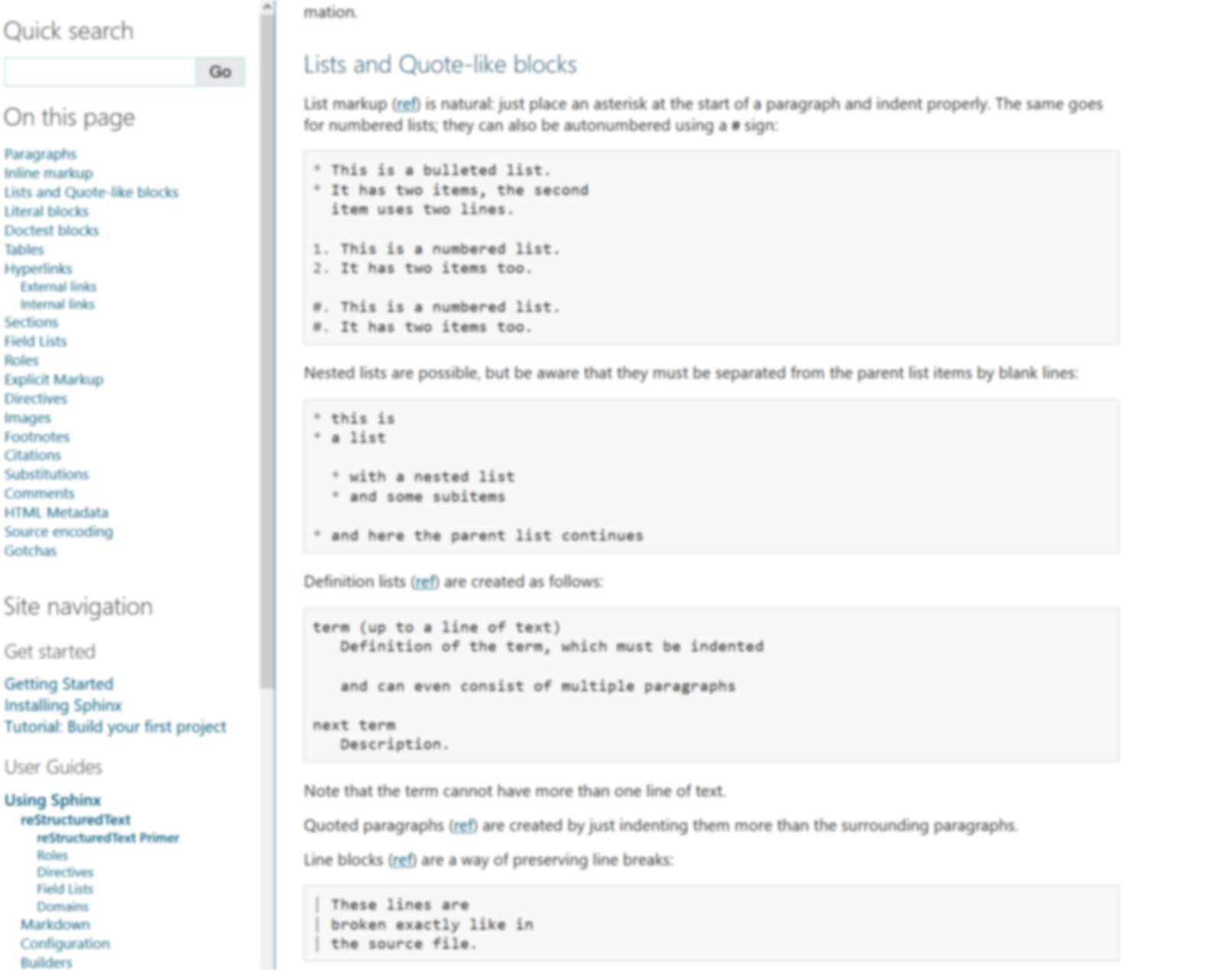
Sphinx und restructuredtext (reST) eignen sich hervoragend um schnell und effizient technische Dokumentation digital niederzuschreiben und als HTML oder PDF zu veröffentlichen. Sphinx nimmt hierbei die Rolle des Parsers ein, während reST die Markdown Sprache ist.
Zum Bsp.: habe ich die Hilfeseite während der Entwicklung des IPCv2 mit Sphinx umgesetzt.
Weiterführende Links:
Sphinx
https://www.sphinx-doc.org/en/master/
Sphinx is a documentation generator or a tool that translates a set of plain text source files into various output formats, automatically producing cross-references, indices, etc. That is, if you have a directory containing a bunch of reStructuredText or Markdown documents, Sphinx can generate a series of HTML files, a PDF file (via LaTeX), man pages and much more.
Sphinx focuses on documentation, in particular handwritten documentation, however, Sphinx can also be used to generate blogs, homepages and even books. Much of Sphinx’s power comes from the richness of its default plain-text markup format, reStructuredText, along with its significant extensibility capabilities.
reST
https://docutils.sourceforge.io/rst.html
reStructuredText is an easy-to-read, what-you-see-is-what-you-get plaintext markup syntax and parser system. It is useful for in-line program documentation (such as Python docstrings), for quickly creating simple web pages, and for standalone documents. reStructuredText is designed for extensibility for specific application domains. The reStructuredText parser is a component of Docutils. reStructuredText is a revision and reinterpretation of the StructuredText and Setext lightweight markup systems.